
An Indian commerce ministry team has reached Washington for another round of talks from Monday on the proposed bilateral trade agreement (BTA), an official said. Chief negotiator of India and special secretary in the Department of Commerce, Rajesh Agrawal, will join the team on Wednesday.

From the Sensex firms, Mahindra & Mahindra, HCL Tech, Tata Motors, Nestle, ITC, Hindustan Unilever, Larsen & Toubro, and Tech Mahindra were the biggest gainers. In contrast, Eternal, UltraTech Cement, Power Grid, Tata Steel and Kotak Mahindra Bank were among the laggards. Eternal dropped 4.51 per cent.

Susim Mukul Datta has not passed away, rather he is the ever-youthful leader to all who knew him, points out R Gopalakrishnan.
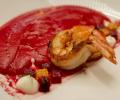
Buttered prawns and the prawn head oil elevates a simple veggie soup.

In trade negotiations, as in chess, sometimes you need to accept a temporary disadvantage to secure a better long-term position, points out Sonal Varma, chief economist (India and Asia ex-Japan) at Nomura.
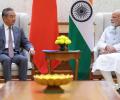
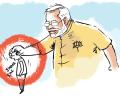
'New Delhi is not naive about its foreign policy choices.'

The Reserve Bank of India (RBI) has started winding down its short position in the dollar forward book, after a gap of seven months, on the back of a softening dollar, while infusing funds via open market operations (OMOs) to counter the resulting liquidity drain.
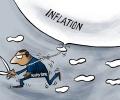
'Deposit and lending rates have started to fall considerably. It is likely to spur investment and consumption of durables.'

Global trends, macroeconomic announcements and US tariff developments are expected to drive stock markets in a holiday-shortened week, analysts said. Market participants will also closely track foreign investor activity, geopolitical tensions, and their impact on the US dollar and crude oil prices, they added.
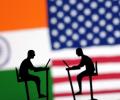
An Indian commerce ministry team will soon visit Washington for another round of talks on the proposed trade agreement with the US to iron out differences in sectors, like agriculture and automobiles, a government official said on Thursday.

Retail inflation declined to over six-year low of 2.1 per cent in June, nearing the RBI's comfort zone, on account of subdued prices of food items, including vegetables, driven by widespread monsoon.

Retail inflation eased to a nearly six-year low of 3.16 per cent in April mainly due to subdued prices of vegetables, fruits, pulses, and other protein-rich items, creating enough room for the Reserve Bank to go for another round of rate cut in the June monetary policy review. The Consumer Price Index (CPI) based inflation was 3.34 per cent in March and 4.83 per cent in April 2024. It was 3.15 per cent in July 2019.

Retail inflation dipped marginally to a nearly six-year low of 3.34 per cent in March due to a decline in prices of vegetables and protein-rich items. The Consumer Price Index (CPI) based inflation was 3.61 per cent in February and 4.85 per cent in March last year.

Benchmark stock indices Sensex and Nifty rallied more than 1.6 per cent to close at lifetime high levels on Thursday following buying in banking, oil and auto shares and a record dividend payout by the RBI to the government. Regaining the 75,000 level after its best single-day gain since January 29, the 30-share BSE Sensex closed at all-time peak of 75,418.04, up by 1,196.98 points or 1.61 per cent over the last close.

Foreign brokerages remain cautious on the road ahead for the Indian equity markets. Though analysts at Nomura have revised their March 2026 Nifty target to 26,140 levels from the earlier 24,970, but the upside from the current levels is a modest 6 per cent. BofA Securities, on the other hand, has not made any change to its year-end Nifty target.
From the Sensex pack, Bharti Airtel, Titan, Tata Consultancy Services, Hindustan Unilever, Infosys, Nestle, Reliance Industries, Mahindra & Mahindra, HDFC Bank and Tata Motors were the biggest gainers. However, IndusInd Bank, Bajaj Finance and UltraTech Cement were the laggards.
From the Sensex firms, Tata Steel, Eternal, Tech Mahindra, Maruti, Mahindra & Mahindra, Infosys, IndusInd Bank, HCL Tech, Tata Consultancy Services and Bharti Airtel were the major gainers. Telecom operator Bharti Airtel climbed nearly 1 per cent after it posted about a five-fold jump in consolidated net profit to Rs 11,022 crore in the March 2025 quarter, mainly due to the tariff hike impact and one-time gain on tax benefits. However, Asian Paints, Tata Motors, Kotak Mahindra Bank, NTPC and Power Grid were among the laggards.

The Organization of the Petroleum Exporting Countries (Opec) and its partners, such as Russia, collectively termed Opec+, have decided to cut crude oil production by 100,000 barrels per day (bpd) from October onwards, at a meeting on Monday. In a step that may increase prices in India, the group has decided to reduce output quotas for October, after a fall in global oil demand outlook. The cut in output is equal to 0.1 per cent of global supply.
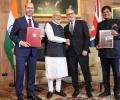
'That way you're not hostage just to US sort of exports to India.'
Maruti, IndusInd Bank, Bajaj Finserv, Eternal, Mahindra & Mahindra, Tata Steel, Kotak Mahindra Bank, Titan, HDFC Bank, and NTPC were among the other major gainers. Bharti Airtel and Sun Pharma were the laggards.
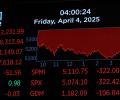
'If the US stagnates and falls into a recession, the dollar will weaken, oil prices will also dip. This augurs well for India.'
Fitch Ratings on Monday said India's steady GDP growth outlook, improved banking sector's financial health and expected interest-rate cuts in 2025 will support credit access for corporates in FY26.
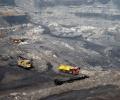
The 17 rare earth elements that are at the centre of the current crisis are critical components of everyday products -- from cars to jet engines to electronics like smartphones and flat-screen TVs.

The RBI on Wednesday slashed key interest rate by 25 basis points, for the second time in a row, to support a shuttering economy hit by reciprocal tariffs imposed by the US. Following the rate cut, the key policy rate eased to 6 per cent providing relief to home, auto and corporate loan borrowers.
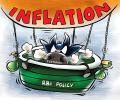
The Reserve Bank on Wednesday lowered the inflation projection for the current fiscal to 4 per cent from 4.2 per cent earlier, taking into account good agricultural output and falling crude prices.

Over the years, with some amount of experimenting, I have learnt exactly what freezes well and what does not.

From the Sensex pack, Bajaj Finserv, Mahindra & Mahindra, Axis Bank, Bajaj Finance, Adani Ports, ICICI Bank, Zomato and UltraTech Cement were among the biggest gainers. However, ITC, Nestle, State Bank of India, Reliance Industries, Asian Paints and Tata Consultancy Services were among the laggards.
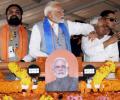
Only in the event of the RSS managing to force Modi into accepting a consensual candidate, will the party not continue to 'being' the 'next Congress', observes Nilanjan Mukhopadhyay.

State Bank of India, Tech Mahindra, Larsen & Toubro, Tata Steel, Sun Pharma, Infosys, HCL Tech, Axis Bank, Tata Consultancy Services and NTPC were among the biggest laggards among Sensex shares. Nestle, Hindustan Unilever, Titan, Power Grid, UltraTech Cement and ITC were among the gainers.

Dividends paid by central public-sector enterprises (CPSEs) in 2024-25 are set to be the highest ever, with the government receiving 69,873 crore so far. A government official said he was hopeful the receipts would touch 70,000 crore in the last week of the financial year.

Bihar is now poised to emerge as one of India's next major destinations for oil and natural gas reserves.

Amid the ongoing global tariff war, Reserve Bank Governor Sanjay Malhotra on Wednesday said he is more worried about its impact on growth than inflation. Speaking to the media after presentation of the first bi-monthly monetary policy for the current financial year, Malhotra said, RBI has reduced the growth forecast for 2025-26 by 20 basis points to 6.5 per cent.

Equity benchmark indices Sensex and Nifty rallied for the third session on the trot, helped by a rally in global markets after lower-than-expected consumer inflation in the US ignited hopes of more rate cuts by the Federal Reserve. The 30-share BSE index climbed 318.74 points or 0.42 per cent to revisit 77,000 level at 77,042.82.

BP Plc has won a bid to operate ONGC's giant Mumbai High oil and gas field by offering up to 60 per cent increase in output over baseline, the state-owned firm said on Wednesday. State-owned Oil and Natural Gas Corporation (ONGC) had in June last year floated a tender seeking foreign partners to reverse declining output at its flagship Mumbai High fields, offering a share of revenue from incremental production plus a fixed fee but not any equity stake.

Among Sensex scrips, Bharti Airtel, Titan, NTPC, State Bank of India, ITC, Tata Steel, Mahindra & Mahindra and Tata Motors were the major laggards. Adani Ports, Infosys, Axis Bank, HCL Technologies, Tech Mahindra and IndusInd Bank were among the gainers.

India's pharmaceutical exports to Iran have been hit owing to depleting rupee reserves in the West Asian country because of India stopping the import of crude oil from it in 2019 following US sanctions. Pharmaceutical exports dropped 71.25 per cent in April-August this year over the same period last year. The data from the Pharmaceutical Exports Promotion Council (Pharmexcil) showed exports to Iran had declined 31.29 per cent in 2022-23 as against the previous financial year.

Titan, Nestle, Hindustan Unilever, State Bank of India, Larsen & Toubro, ITC, Zomato and Bajaj Finserv were also among the laggards. Adani Ports, IndusInd Bank, Tata Motors and HDFC Bank were among the major gainers.
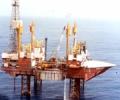
ONGC has about 1,200 drilling wells in Mehsana. The new location will require about 500 wells to be drilled and the estimated investment for this would be about Rs 500 crore, industry sources said. ONGC has completed the seismic study of the area and will start drilling once it gets the requisite permissions.

The ongoing Hamas-Israel conflict has disrupted India's efforts to gain from a recent fall in crude oil prices. Since Hamas' invasion of southern Israel on October 7, petroleum has become costlier by around $5 per barrel, threatening to stoke prices and impact growth. Brent crude was trading at $89.8 per barrel on October 9 (9.15 pm IST), up over 4 per cent, thwarting India's anticipation of a period of declining oil prices - after the leading global petroleum benchmark declined by around 11 per cent last week.
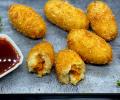
Bite into these alu croquettes and experience the wee explosion of pickle and creaminess.
